

Appliance power stations with solar input
Enough output for a fridge, and a published solar input to keep it going past the first day.
Every figure here is taken from the manufacturer’s published listing and measured against the rest of the group. We do not test power stations. Where a listing is silent, this site prints not stated rather than a plausible default.
What this group looks like
| Measure | Middle half | Median |
|---|---|---|
| Capacity | 828 Wh – 1,024 Wh | 999 Wh |
| Continuous output | 1,000 W – 1,024 W | 1,000 W |
| Runtime at full output (derived) | 58 min – 1h 1m | 1h 0m |
| Energy per kilogram (derived) | — | 89 Wh/kg |
The middle-half column spans the 25th to 75th percentile, so it describes where most of this group sits rather than being pulled about by one unusual unit.
The runtime figure is arithmetic, and it is optimistic. It is the published capacity divided by the published output, which is the best you could ever get. Real inverters are 85 to 90% efficient, so the usable figure is lower — and no listing on this site states its inverter efficiency, so we do not estimate it. Treat the number as a ceiling and a way to compare like with like, not as a promise.
Against the market as a whole this group runs longer at full output than average — a median of 1h 0m against 51 min overall, a difference of 18%.
What these listings publish
Specification coverage is uneven, and knowing where it runs out is part of shopping honestly.
| Specification | Stated | Share |
|---|---|---|
| Continuous output | 13 | 100% |
| Capacity in watt-hours | 12 | 92% |
| Surge rating | 8 | 62% |
| Cell chemistry | 9 | 69% |
| Solar input | 13 | 100% |
| Weight | 11 | 85% |
What they cost
Bands, not prices. Panels, where you need them, are almost always a separate purchase.
| Band | Listings | Share |
|---|---|---|
| Under $200 | 1 | 8% |
| $200–400 | 8 | 62% |
| $400–800 | 3 | 23% |
| $800–1,500 | 1 | 8% |
This combination is the off-grid fridge case
A fridge is the appliance most people actually want to keep running, and it is a cycling load rather than a continuous one — which makes it tractable on a battery that can also refill during daylight. The output rating decides whether the compressor starts; the solar input decides whether day two looks like day one.
Match the panel to the day, not to the battery
Sizing solar to refill the whole battery every day is usually the wrong target and an expensive one. Sizing it to replace what the fridge actually consumes is the useful calculation, and it needs the appliance’s daily kilowatt-hours rather than its wattage.
Solar at this capacity is a multi-day proposition
An appliance-class station holds roughly a kilowatt-hour, and refilling that from a panel rated at the median input in this corpus takes the better part of a sunny day in ideal conditions — which real panels do not sustain. The realistic planning figure is closer to two days of ordinary weather. That makes solar useful for extending a stay off-grid and close to useless for recovering from an overnight outage, and the distinction decides whether the panel is worth buying at all.
The panel is a separate purchase and a separate decision
Around half the stations here state a solar input, and stating one describes a capability rather than a bundle. The connector, the voltage window and the maximum current all have to match, and a panel outside the station’s voltage window will not charge it regardless of its wattage. That mismatch is the most common reason a correctly sized panel does nothing, and it is checked from two specifications that appear on different product pages.
Where this combination genuinely fits
A station of this size with solar suits a long weekend away from mains with a fridge or a CPAP running: enough capacity to carry the load overnight, enough input to recover something during the day. It does not suit a household treating it as backup, because the outage will end before the panel matters, and it does not suit a work site, where the loads are larger than this class serves.
Surge is the figure that decides whether a motor starts
Stations quote a continuous rating and a surge rating roughly double it, and the surge covers the instant a compressor or a pump starts. It is stated on only about half the listings in this corpus, which is why the finder keeps unstated values visible rather than assuming them. A station rated comfortably above a device’s running draw can still fail to start it, and the specification that would have predicted that is the one most often missing.
Measuring what you actually draw
The arithmetic is only as good as the wattage that goes into it, and most people take that from a label describing the maximum a device can draw rather than what it usually does. A plug-in energy meter costs very little and turns a guess into a measurement — a fridge rated at a few hundred watts averages a fraction of that across a day because the compressor is off most of the time. Measuring the real load is the single change that makes every other figure useful.
The total output is not the per-socket rating
A station quoting a large continuous figure is describing what the inverter delivers in total, not what any one outlet will carry. Individual sockets are frequently rated lower, and a single heavy load in the wrong one trips it while the station reports plenty of headroom. Where a station has several AC outlets it is worth knowing whether they share one rating or divide it, and that detail sits in the manual rather than the listing on almost every model here.
Before you buy
Check watts before watt-hours
A station rated below your appliance’s draw will not start it for one second, whatever its battery holds. Establish the output ceiling you need first; the capacity question only matters once the appliance runs at all.
Find the surge rating
Anything with a motor or compressor draws several times its running wattage for a fraction of a second at startup. Where a listing does not state a surge rating, this site says so rather than assuming it is generous.
Treat marketing language as a claim
“Solar generator”, “whole-home backup” and “portable” are positioning, not specifications. Look for the number behind each: a solar input in watts, an output in watts, a weight in kilograms.
Compare them
The finder below is already filtered to this group. Every result carries its runtime at full output.
27 power stations match

UDPOWER S1200 1190Wh Solar Generator Kit with 120W Panel, 1200W Power Station, for Home Backup RV Outdoor, Emergency Power Backup
- At full output
- 60min
- Continuous output
- 1200W
- Surge
- 1800W
- Cells
- LiFePO4
- Solar input
- 120W
- Weight
- 26lb
Capacity
1,190Wh
Appliance · 500 – 1,200 Wh · 40 power stations
Energy per kilogram
102Wh per kg
+15% vs the 88 median — more energy for the weight than most of its class
Capacity is +19% against the class median of 1,000.

VTOMAN FlashSpeed 1000 Portable Power Station, 828Wh LiFePO4,1000W output
- At full output
- 50min
- Continuous output
- 1000W
- Surge
- 2000W
- Cells
- LiFePO4
- Solar input
- 400W
- Weight
- 32lb
Capacity
828Wh
Appliance · 500 – 1,200 Wh · 40 power stations
Energy per kilogram
58Wh per kg
-35% vs the 88 median — heavier than most of its class for the energy
Capacity is -17% against the class median of 1,000.

DaranEner Portable Power Station 600W (1200W Peak), 576Wh LiFePO4 battery with 100W Solar Panel, Fast Recharge AC/Car/Solar, 3 AC Outlets, USB-C PD for Camping, RV, CPAP, Emergency Backup
- At full output
- 58min
- Continuous output
- 600W
- Surge
- 1200W
- Cells
- LiFePO4
- Solar input
- 100W
- Weight
- 14lb
Capacity
576Wh
Appliance · 500 – 1,200 Wh · 40 power stations
Energy per kilogram
93Wh per kg
+5% vs the 88 median — typical for its class
Capacity is -42% against the class median of 1,000.

1000W Portable Power Station 1024Wh LiFePO4 for Outdoor & Home
- At full output
- 61min
- Continuous output
- 1000W
- Surge
- not stated
- Cells
- LiFePO4
- Solar input
- 200W
- Weight
- 28lb
Capacity
1,024Wh
Appliance · 500 – 1,200 Wh · 40 power stations
Energy per kilogram
82Wh per kg
-8% vs the 88 median — typical for its class
Capacity is +2% against the class median of 1,000.

1000W Portable Power Station 1024Wh LiFePO4 for Outdoor & Home
- At full output
- 61min
- Continuous output
- 1000W
- Surge
- not stated
- Cells
- LiFePO4
- Solar input
- 200W
- Weight
- 28lb
Capacity
1,024Wh
Appliance · 500 – 1,200 Wh · 40 power stations
Energy per kilogram
82Wh per kg
-8% vs the 88 median — typical for its class
Capacity is +2% against the class median of 1,000.
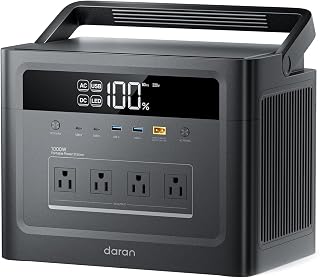
Portable Power Station 2000W Surge, Solar Generator 1000W, 960Wh
- At full output
- 58min
- Continuous output
- 1000W
- Surge
- 2000W
- Cells
- LiFePO4
- Solar input
- not stated
- Weight
- 23lb
Capacity
960Wh
Appliance · 500 – 1,200 Wh · 40 power stations
Energy per kilogram
92Wh per kg
+4% vs the 88 median — typical for its class
Capacity is -4% against the class median of 1,000.

DaranEner Portable Power Station 1200W Peak, 576Wh LiFePO4 Power Bank with Built-in UPS Backup, 600W Power Station, 1.1H Fast Charge Solar Generator for Camping Home Emergency RV Power Outage
- At full output
- 58min
- Continuous output
- 600W
- Surge
- 1200W
- Cells
- LiFePO4
- Solar input
- not stated
- Weight
- 15lb
Capacity
576Wh
Appliance · 500 – 1,200 Wh · 40 power stations
Energy per kilogram
84Wh per kg
-5% vs the 88 median — typical for its class
Capacity is -42% against the class median of 1,000.

600W Portable Power Station, 296Wh Lithium Solar Generator for Camping
- At full output
- 30min
- Continuous output
- 600W
- Surge
- not stated
- Cells
- Lithium-ion
- Solar input
- not stated
- Weight
- 10lb
Capacity
296Wh
Appliance · under 500 Wh · 42 power stations
Energy per kilogram
66Wh per kg
-11% vs the 74 median — heavier than most of its class for the energy
Capacity is +25% against the class median of 237.

EF ECOFLOW Portable Power Station RIVER 2, 256Wh 300W
- At full output
- 26min
- Continuous output
- 600W
- Surge
- not stated
- Cells
- LiFePO4
- Solar input
- 110W
- Weight
- 8lb
Capacity
256Wh
Appliance · under 500 Wh · 42 power stations
Energy per kilogram
73Wh per kg
-2% vs the 74 median — typical for its class
Capacity is +8% against the class median of 237.

UDPOWER S1200 Portable Power Station 1200W (Surge 1800W), Max 400W Solar Input, UPS, UL2743, for Home RV Emergency, Pure Sine Wave
- At full output
- not stated
- Continuous output
- 1200W
- Surge
- 1800W
- Cells
- LiFePO4
- Solar input
- 400W
- Weight
- 26lb
Capacity
Not stated
This listing does not publish a figure, so it cannot be placed against the baseline.

FOSSIBOT F2400 Portable Power Station, 2048Wh LiFePO4 Solar Generator, 2400W (4800W Surge) AC Output, 1100W Adjustable Fast Charging, 15ms UPS Battery Backup for Home Use, Power Outage, RV, Off-Grid
- At full output
- 112min
- Continuous output
- 1100W
- Surge
- 4800W
- Cells
- LiFePO4
- Solar input
- 500W
- Weight
- not stated
Capacity
2,048Wh
Appliance · 1,200 – 2,500 Wh · 20 power stations
Energy per kilogram
Weight not stated, so energy per kilogram cannot be computed.
Capacity is +2% against the class median of 2,016.

BLUETTI Elite 100 V2 Portable Power Station with Solar Cable 1024Wh 1800W
- At full output
- 60min
- Continuous output
- 1024W
- Surge
- not stated
- Cells
- not stated
- Solar input
- 1000W
- Weight
- 25lb
Capacity
1,024Wh
Appliance · 500 – 1,200 Wh · 40 power stations
Energy per kilogram
89Wh per kg
+1% vs the 88 median — typical for its class
Capacity is +2% against the class median of 1,000.
Related
- The full power station finder — unfiltered, every output class.
- How long does a power station actually run? — the full table.
- Appliance Power Stations — the full class, with baselines for every specification.
- How we compile these figures.