

LiFePO4 power stations under 600 W
The long-life chemistry at the size you actually carry — where its weight penalty is felt most and its cycle life matters least.
Every figure here is taken from the manufacturer’s published listing and measured against the rest of the group. We do not test power stations. Where a listing is silent, this site prints not stated rather than a plausible default.
What this group looks like
| Measure | Middle half | Median |
|---|---|---|
| Capacity | 192 Wh – 288 Wh | 230 Wh |
| Continuous output | 200 W – 300 W | 300 W |
| Runtime at full output (derived) | 38 min – 58 min | 51 min |
| Energy per kilogram (derived) | — | 74 Wh/kg |
The middle-half column spans the 25th to 75th percentile, so it describes where most of this group sits rather than being pulled about by one unusual unit.
The runtime figure is arithmetic, and it is optimistic. It is the published capacity divided by the published output, which is the best you could ever get. Real inverters are 85 to 90% efficient, so the usable figure is lower — and no listing on this site states its inverter efficiency, so we do not estimate it. Treat the number as a ceiling and a way to compare like with like, not as a promise.
Against the market as a whole this group runs about as long at full output as average — a median of 51 min against 51 min overall.
What these listings publish
Specification coverage is uneven, and knowing where it runs out is part of shopping honestly.
| Specification | Stated | Share |
|---|---|---|
| Continuous output | 30 | 100% |
| Capacity in watt-hours | 20 | 67% |
| Surge rating | 22 | 73% |
| Cell chemistry | 30 | 100% |
| Solar input | 15 | 50% |
| Weight | 23 | 77% |
What they cost
Bands, not prices. Panels, where you need them, are almost always a separate purchase.
| Band | Listings | Share |
|---|---|---|
| Under $200 | 24 | 80% |
| $200–400 | 6 | 20% |
The trade is sharpest here
LiFePO4 buys roughly ten times the cycle life for a meaningful weight penalty. In a station carried to a campsite four times a year the cycle life will never be reached and the weight is felt every trip; in one used weekly as a desk backup the opposite is true. This is the one class where the honest answer depends entirely on how often you will actually use it.
Small does not mean simple
Output ceilings inside this class range from a couple of hundred watts to nearly six hundred, which is the difference between charging a laptop and running a small television. Check the continuous rating before the chemistry.
Chemistry matters least where the station is smallest
LiFePO4 buys cycle life at a cost in weight, and at this capacity the weight is small enough that the trade barely registers — which is why almost the whole class has moved to it. The cycle argument is also weakest here: a station used for phones, lights and a router on occasional trips may see a few dozen cycles a year, and a few thousand cycles is a lifetime either way. What the chemistry genuinely buys at this size is tolerance of heat and a battery that ages more slowly while sitting unused.
Sitting unused is what these actually do
An essentials station spends most of its life charged and idle, and that is a duty cycle rather than an absence of one. Lithium packs age while stored, faster when held at full charge and faster still when warm. Storing at a partial charge and topping up a few times a year is gentler than leaving it permanently on the charger, and it is the difference between a station that still holds its capacity in year five and one that does not.
The ports decide what this is for
At this size the sockets matter more than the specification: how many AC outlets, whether the USB-C port delivers enough to charge a laptop at full rate rather than only a phone, and whether there is a 12 V output. A station with ample watt-hours and one AC socket is awkward in exactly the situation it was bought for, and port counts are stated far more reliably than surge ratings are.
Nobody publishes the cycle count
Cycle life is the headline durability claim for this chemistry and not one listing in this corpus states it in a form that can be read and compared. The figure quoted in marketing comes from the cell manufacturer rather than the station builder and assumes a regime no owner replicates. This site prints not stated rather than repeating it, and the practical substitute is the warranty — the only durability claim anyone has to honour.
Cold is the condition that changes the answer
Every lithium chemistry loses usable capacity in the cold, and charging below freezing is the operation that does lasting damage. Many units include a heater or simply refuse to charge until the pack warms, and refusing is the correct behaviour. For a unit kept in a vehicle or an unheated garage through winter this matters more than any figure on the listing, and it is rarely stated.
The total output is not the per-socket rating
A station quoting a large continuous figure is describing what the inverter delivers in total, not what any one outlet will carry. Individual sockets are frequently rated lower, and a single heavy load in the wrong one trips it while the station reports plenty of headroom. Where a station has several AC outlets it is worth knowing whether they share one rating or divide it, and that detail sits in the manual rather than the listing on almost every model here.
Before you buy
Check watts before watt-hours
A station rated below your appliance’s draw will not start it for one second, whatever its battery holds. Establish the output ceiling you need first; the capacity question only matters once the appliance runs at all.
Find the surge rating
Anything with a motor or compressor draws several times its running wattage for a fraction of a second at startup. Where a listing does not state a surge rating, this site says so rather than assuming it is generous.
Treat marketing language as a claim
“Solar generator”, “whole-home backup” and “portable” are positioning, not specifications. Look for the number behind each: a solar input in watts, an output in watts, a weight in kilograms.
Compare them
The finder below is already filtered to this group. Every result carries its runtime at full output.
55 power stations match
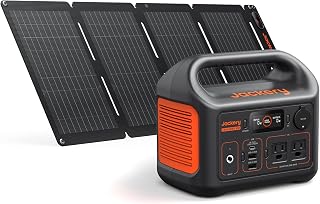
Jackery Solar Generator 300 and 40W Solar Panel,292Wh,300W AC
- At full output
- 58min
- Continuous output
- 300W
- Surge
- 600W
- Cells
- LiFePO4
- Solar input
- 40W
- Weight
- 13lb
Capacity
292Wh
Essentials · under 500 Wh · 42 power stations
Energy per kilogram
50Wh per kg
-33% vs the 74 median — heavier than most of its class for the energy
Capacity is +23% against the class median of 237.

ALLWEI Portable Power Station 300W, 256Wh Solar Generator LiFePO4 Battery
- At full output
- 51min
- Continuous output
- 300W
- Surge
- 600W
- Cells
- LiFePO4
- Solar input
- 100W
- Weight
- 6lb
Capacity
256Wh
Essentials · under 500 Wh · 42 power stations
Energy per kilogram
88Wh per kg
+19% vs the 74 median — more energy for the weight than most of its class
Capacity is +8% against the class median of 237.

300W Portable Power Station 80000mAh LiFePO4 Battery
- At full output
- 51min
- Continuous output
- 300W
- Surge
- not stated
- Cells
- LiFePO4
- Solar input
- 100W
- Weight
- 6lb
Capacity
256Wh
Essentials · under 500 Wh · 42 power stations
Energy per kilogram
87Wh per kg
+17% vs the 74 median — more energy for the weight than most of its class
Capacity is +8% against the class median of 237.

DaranEner 300W Portable Power Station, 192Wh LiFePO4 Solar Generator
- At full output
- 38min
- Continuous output
- 300W
- Surge
- 600W
- Cells
- LiFePO4
- Solar input
- 60W
- Weight
- 6lb
Capacity
192Wh
Essentials · under 500 Wh · 42 power stations
Energy per kilogram
74Wh per kg
0% vs the 74 median — typical for its class
Capacity is -19% against the class median of 237.

Portable Power Station 300W, 192Wh Large Power Bank with 110V AC Outlet, LiFePO4 Battery Backup, 8- Ports Solar Generator Fast Charaing for Camping, Hurricane Emergency, Outdoor, Home
- At full output
- 38min
- Continuous output
- 300W
- Surge
- 600W
- Cells
- LiFePO4
- Solar input
- 60W
- Weight
- 6lb
Capacity
192Wh
Essentials · under 500 Wh · 42 power stations
Energy per kilogram
73Wh per kg
-2% vs the 74 median — typical for its class
Capacity is -19% against the class median of 237.
Daran 300W Portable Power Station (600W Surge) | 192Wh LiFePO4 Solar Generator for Camping, RV & Emergency | 8-in-1 Lightweight Battery Supply with 60W PD & LED Light for Laptop, Drone
- At full output
- 38min
- Continuous output
- 300W
- Surge
- 600W
- Cells
- LiFePO4
- Solar input
- 60W
- Weight
- 6lb
Capacity
192Wh
Essentials · under 500 Wh · 42 power stations
Energy per kilogram
73Wh per kg
-2% vs the 74 median — typical for its class
Capacity is -19% against the class median of 237.

Portable Power Station 500W, 519.48Wh/140400mAh Solar Generator Backup
- At full output
- 62min
- Continuous output
- 500W
- Surge
- not stated
- Cells
- not stated
- Solar input
- 200W
- Weight
- 14lb
Capacity
519Wh
Essentials · 500 – 1,200 Wh · 40 power stations
Energy per kilogram
81Wh per kg
-8% vs the 88 median — typical for its class
Capacity is -48% against the class median of 1,000.

Jackery Explorer 500 v2 Portable Power Station,512Wh,500W AC
- At full output
- 61min
- Continuous output
- 500W
- Surge
- 1000W
- Cells
- LiFePO4
- Solar input
- not stated
- Weight
- 13lb
Capacity
512Wh
Essentials · 500 – 1,200 Wh · 40 power stations
Energy per kilogram
85Wh per kg
-4% vs the 88 median — typical for its class
Capacity is -49% against the class median of 1,000.

ANTPO 500W Portable Power Station, 500Wh LiFePO4 Solar Generator Pure Sine Wave 110V AC Car Outlets PD 60W QC3.0 Backup Power Supply Bank for Camping, Blackout,
- At full output
- 60min
- Continuous output
- 500W
- Surge
- 1000W
- Cells
- LiFePO4
- Solar input
- 200W
- Weight
- not stated
Capacity
500Wh
Essentials · 500 – 1,200 Wh · 40 power stations
Energy per kilogram
Weight not stated, so energy per kilogram cannot be computed.
Capacity is -50% against the class median of 1,000.

2026 Portable Power Station 700W Surge, 288Wh LiFePO4 Battery Backup, Power Bank with AC Outlet 350W/110V, Solar Generator Fast Charging for Camping Essentials, Hurricane Emergency, Home, Road Trips
- At full output
- 49min
- Continuous output
- 350W
- Surge
- 700W
- Cells
- LiFePO4
- Solar input
- not stated
- Weight
- 7lb
Capacity
288Wh
Essentials · under 500 Wh · 42 power stations
Energy per kilogram
88Wh per kg
+19% vs the 74 median — more energy for the weight than most of its class
Capacity is +22% against the class median of 237.
DaranEner Portable Power Station, 192Wh LiFePO4 Battery Backup Solar Generator with w/2 300W (Peak 600W) AC Outlets, USB-C PD 60W Fast Charge, Power Bank for Camping, Outdoor, Home,Emergency
- At full output
- 38min
- Continuous output
- 300W
- Surge
- 600W
- Cells
- LiFePO4
- Solar input
- not stated
- Weight
- 6lb
Capacity
192Wh
Essentials · under 500 Wh · 42 power stations
Energy per kilogram
74Wh per kg
0% vs the 74 median — typical for its class
Capacity is -19% against the class median of 237.

Portable Power Station 300W, 600W Peak Solar Generator 192Wh
- At full output
- 38min
- Continuous output
- 300W
- Surge
- 600W
- Cells
- LiFePO4
- Solar input
- 300W
- Weight
- not stated
Capacity
192Wh
Essentials · under 500 Wh · 42 power stations
Energy per kilogram
Weight not stated, so energy per kilogram cannot be computed.
Capacity is -19% against the class median of 237.
Related
- The full power station finder — unfiltered, every output class.
- How long does a power station actually run? — the full table.
- Essentials Power Stations — the full class, with baselines for every specification.
- How we compile these figures.