

LiFePO4 power stations from 1,500 to 2,500 W
Microwave-and-power-tool output on the chemistry that survives being used that way.
Every figure here is taken from the manufacturer’s published listing and measured against the rest of the group. We do not test power stations. Where a listing is silent, this site prints not stated rather than a plausible default.
What this group looks like
| Measure | Middle half | Median |
|---|---|---|
| Capacity | 1,024 Wh – 2,048 Wh | 1,843 Wh |
| Continuous output | 1,800 W – 2,400 W | 1,800 W |
| Runtime at full output (derived) | 34 min – 1h 20m | 46 min |
| Energy per kilogram (derived) | — | 88 Wh/kg |
The middle-half column spans the 25th to 75th percentile, so it describes where most of this group sits rather than being pulled about by one unusual unit.
The runtime figure is arithmetic, and it is optimistic. It is the published capacity divided by the published output, which is the best you could ever get. Real inverters are 85 to 90% efficient, so the usable figure is lower — and no listing on this site states its inverter efficiency, so we do not estimate it. Treat the number as a ceiling and a way to compare like with like, not as a promise.
Against the market as a whole this group runs shorter at full output than average — a median of 46 min against 51 min overall, a difference of 10%.
What these listings publish
Specification coverage is uneven, and knowing where it runs out is part of shopping honestly.
| Specification | Stated | Share |
|---|---|---|
| Continuous output | 38 | 100% |
| Capacity in watt-hours | 35 | 92% |
| Surge rating | 13 | 34% |
| Cell chemistry | 38 | 100% |
| Solar input | 21 | 55% |
| Weight | 30 | 79% |
What they cost
Bands, not prices. Panels, where you need them, are almost always a separate purchase.
| Band | Listings | Share |
|---|---|---|
| $200–400 | 5 | 13% |
| $400–800 | 26 | 68% |
| $800–1,500 | 7 | 18% |
Heavy loads and long life belong together
A station in this class is bought to run things that draw hard — heating elements, motors, tools — and that usually means it is bought to be used rather than kept for emergencies. Cycle life stops being theoretical at that point, which is why LiFePO4 dominates the class and why the exceptions are worth a second look.
Weight is no longer the objection
At 20 to 30 kilograms these are sited or wheeled rather than carried, so the weight penalty that argues against LiFePO4 in a camping station argues for very little here. Energy per kilogram is still worth reading, but as a proxy for pack quality rather than for portability.
Where the chemistry earns its weight
At this output the pack is large, and LiFePO4 adds meaningful kilograms over the lithium-ion alternative for the same watt-hours. What it returns is cycle life measured in thousands rather than hundreds, which matters because a station in this class is generally bought to be used rather than kept — job sites, long trips, regular outages. A station cycled weekly reaches the end of a lithium-ion pack in a few years and is barely started on a LiFePO4 one.
Heat is the other half of the chemistry argument
LiFePO4 tolerates heat considerably better and is far less prone to thermal runaway, which is the argument that matters for a large pack run hard indoors or left in a vehicle. It does not make any battery inert, and it does not remove the need for ventilation or the sense in not charging unattended on soft furnishings. It shifts the risk rather than eliminating it, and at this capacity the quantity of stored energy is large enough for the shift to be worth paying for.
Recharging a pack this size
Large capacity means long recharge, and mains charge rates vary far more between models at this size than capacity does. A station here on a slow charger is an overnight job; on a fast one it is a couple of hours, usually with audible fans. For a unit used as outage cover the recharge rate decides whether it is ready for the second interruption in a week, and it is rarely the figure the listing leads with.
Nobody publishes the cycle count
Cycle life is the headline durability claim for this chemistry and not one listing in this corpus states it in a form that can be read and compared. The figure quoted in marketing comes from the cell manufacturer rather than the station builder and assumes a regime no owner replicates. This site prints not stated rather than repeating it, and the practical substitute is the warranty — the only durability claim anyone has to honour.
Surge is the figure that decides whether a motor starts
Stations quote a continuous rating and a surge rating roughly double it, and the surge covers the instant a compressor or a pump starts. It is stated on only about half the listings in this corpus, which is why the finder keeps unstated values visible rather than assuming them. A station rated comfortably above a device’s running draw can still fail to start it, and the specification that would have predicted that is the one most often missing.
The total output is not the per-socket rating
A station quoting a large continuous figure is describing what the inverter delivers in total, not what any one outlet will carry. Individual sockets are frequently rated lower, and a single heavy load in the wrong one trips it while the station reports plenty of headroom. Where a station has several AC outlets it is worth knowing whether they share one rating or divide it, and that detail sits in the manual rather than the listing on almost every model here.
Before you buy
Check watts before watt-hours
A station rated below your appliance’s draw will not start it for one second, whatever its battery holds. Establish the output ceiling you need first; the capacity question only matters once the appliance runs at all.
Find the surge rating
Anything with a motor or compressor draws several times its running wattage for a fraction of a second at startup. Where a listing does not state a surge rating, this site says so rather than assuming it is generous.
Treat marketing language as a claim
“Solar generator”, “whole-home backup” and “portable” are positioning, not specifications. Look for the number behind each: a solar input in watts, an output in watts, a weight in kilograms.
Compare them
The finder below is already filtered to this group. Every result carries its runtime at full output.
47 power stations match

UDPOWER S2400 Portable Power Station(Solar Panel Option), 2083Wh LiFePO4, 2400W (Surge 3000W) UPS, 6 AC Outlets, Solar Generator for RVs Camping Emergency, Home Backup (One Unit(AS2400))
- At full output
- 52min
- Continuous output
- 2400W
- Surge
- 3000W
- Cells
- LiFePO4
- Solar input
- 440W
- Weight
- 41lb
Capacity
2,083Wh
High output · 1,200 – 2,500 Wh · 20 power stations
Energy per kilogram
112Wh per kg
+31% vs the 86 median — more energy for the weight than most of its class
Capacity is +3% against the class median of 2,016.
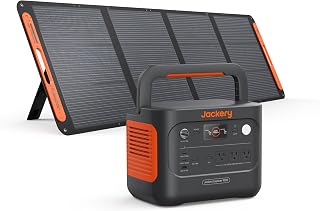
Jackery Solar Generator 1000 v2 and 200W Solar Panel,1070Wh,1500W AC
- At full output
- 43min
- Continuous output
- 1500W
- Surge
- 3000W
- Cells
- LiFePO4
- Solar input
- 200W
- Weight
- 24lb
Capacity
1,070Wh
High output · 500 – 1,200 Wh · 40 power stations
Energy per kilogram
99Wh per kg
+12% vs the 88 median — more energy for the weight than most of its class
Capacity is +7% against the class median of 1,000.
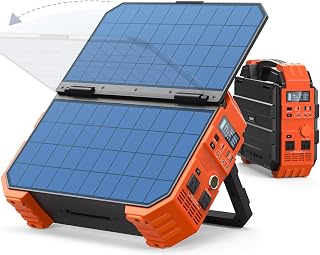
BLAVOR Portable Power Station 1600W (Peak 3200W), Built-in Solar Panel, 1024Wh LiFePO4 Battery, 100W USB-C Fast Charge, Solar Generator for Home Backup, Camping, Power Outages & RV
- At full output
- 38min
- Continuous output
- 1600W
- Surge
- 3200W
- Cells
- LiFePO4
- Solar input
- 40W
- Weight
- 26lb
Capacity
1,024Wh
High output · 500 – 1,200 Wh · 40 power stations
Energy per kilogram
87Wh per kg
-2% vs the 88 median — typical for its class
Capacity is +2% against the class median of 1,000.

BLUETTI Solar Generator Elite 300 with 350W Solar Panel Included, 3014.4Wh
- At full output
- 75min
- Continuous output
- 2400W
- Surge
- 4800W
- Cells
- not stated
- Solar input
- 350W
- Weight
- 58lb
Capacity
3,000Wh
High output · 2,500 – 5,000 Wh · 19 power stations
Energy per kilogram
114Wh per kg
+16% vs the 98 median — more energy for the weight than most of its class
Capacity is -2% against the class median of 3,072.

AFERIY P210 Solar Generator 2048Wh Portable Power Station 2400W (4800W Peak
- At full output
- 51min
- Continuous output
- 2400W
- Surge
- 4800W
- Cells
- LiFePO4
- Solar input
- not stated
- Weight
- 54lb
Capacity
2,048Wh
High output · 1,200 – 2,500 Wh · 20 power stations
Energy per kilogram
84Wh per kg
-2% vs the 86 median — typical for its class
Capacity is +2% against the class median of 2,016.

Anker SOLIX S2000 Portable Power Station, 2,010Wh, 3,000W Peak, Home Backup
- At full output
- 80min
- Continuous output
- 1500W
- Surge
- 3000W
- Cells
- LiFePO4
- Solar input
- 400W
- Weight
- 36lb
Capacity
2,000Wh
High output · 1,200 – 2,500 Wh · 20 power stations
Energy per kilogram
124Wh per kg
+44% vs the 86 median — more energy for the weight than most of its class
Capacity is -1% against the class median of 2,016.

Anker SOLIX S2000 Portable Power Station (2-Pack), 4,020Wh, 3,000W Peak
- At full output
- 80min
- Continuous output
- 1500W
- Surge
- 3000W
- Cells
- LiFePO4
- Solar input
- 400W
- Weight
- 36lb
Capacity
2,000Wh
High output · 1,200 – 2,500 Wh · 20 power stations
Energy per kilogram
124Wh per kg
+44% vs the 86 median — more energy for the weight than most of its class
Capacity is -1% against the class median of 2,016.

2400W Portable Power Station with 2x100W Solar Panel (Ship Separately)
- At full output
- 46min
- Continuous output
- 2400W
- Surge
- not stated
- Cells
- LiFePO4
- Solar input
- 100W
- Weight
- 55lb
Capacity
1,843Wh
High output · 1,200 – 2,500 Wh · 20 power stations
Energy per kilogram
74Wh per kg
-14% vs the 86 median — heavier than most of its class for the energy
Capacity is -9% against the class median of 2,016.

Portable Power Station 2400W Solar Generator for Home Use
- At full output
- 46min
- Continuous output
- 2400W
- Surge
- not stated
- Cells
- LiFePO4
- Solar input
- 2400W
- Weight
- 56lb
Capacity
1,843Wh
High output · 1,200 – 2,500 Wh · 20 power stations
Energy per kilogram
73Wh per kg
-14% vs the 86 median — heavier than most of its class for the energy
Capacity is -9% against the class median of 2,016.

Jackery Explorer 1000 v2 Portable Power Station,1070Wh,1500W
- At full output
- 43min
- Continuous output
- 1500W
- Surge
- 3000W
- Cells
- LiFePO4
- Solar input
- not stated
- Weight
- 24lb
Capacity
1,070Wh
High output · 500 – 1,200 Wh · 40 power stations
Energy per kilogram
99Wh per kg
+12% vs the 88 median — more energy for the weight than most of its class
Capacity is +7% against the class median of 1,000.

EF ECOFLOW Portable Power Station Delta 3 Classic, 1024Wh 1800W AC
- At full output
- 34min
- Continuous output
- 1800W
- Surge
- 3600W
- Cells
- LiFePO4
- Solar input
- 500W
- Weight
- 27lb
Capacity
1,024Wh
High output · 500 – 1,200 Wh · 40 power stations
Energy per kilogram
85Wh per kg
-4% vs the 88 median — typical for its class
Capacity is +2% against the class median of 1,000.
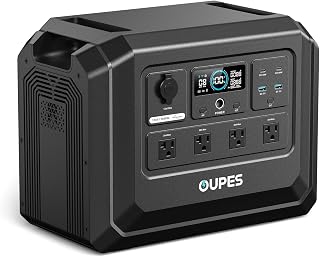
OUPES Mega 1 Lite Portable Power Station 1024Wh 2000W (4500W Surge)
- At full output
- 31min
- Continuous output
- 2000W
- Surge
- 4500W
- Cells
- not stated
- Solar input
- 800W
- Weight
- 27lb
Capacity
1,024Wh
High output · 500 – 1,200 Wh · 40 power stations
Energy per kilogram
85Wh per kg
-4% vs the 88 median — typical for its class
Capacity is +2% against the class median of 1,000.
Related
- The full power station finder — unfiltered, every output class.
- How long does a power station actually run? — the full table.
- High-Output Power Stations — the full class, with baselines for every specification.
- How we compile these figures.